
From a single blast to a single customer: the actual sequence
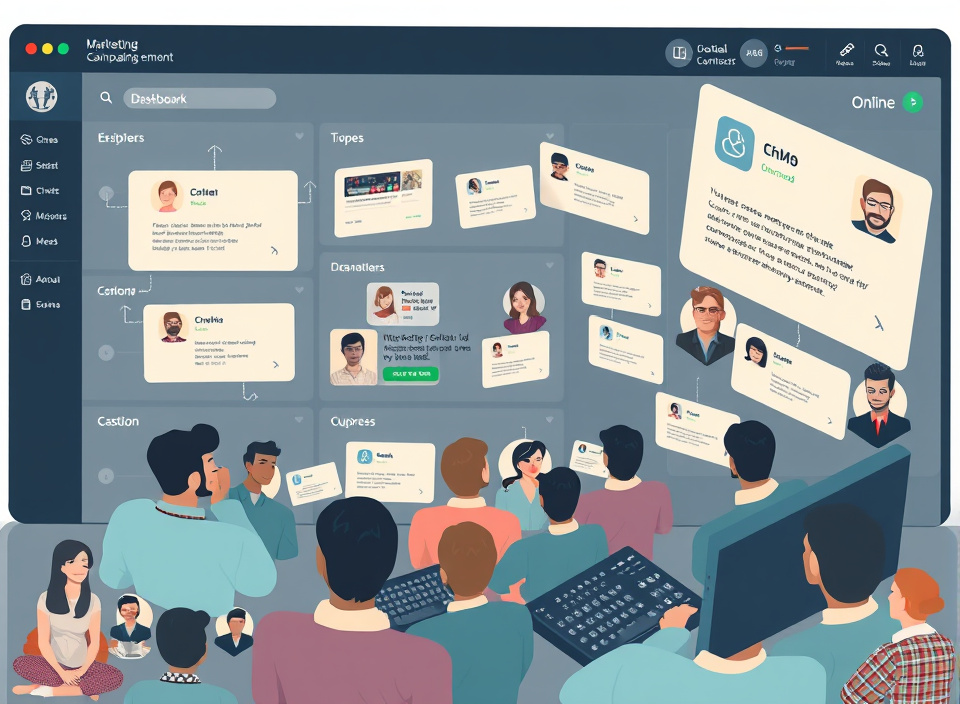
A broad, generic campaign sends the same email, the same ad, and the same landing page to everyone on a list or in an audience, regardless of what any individual has bought, clicked, or ignored before. This is where most marketing programs start, not because it's the best approach but because it's the cheapest one to set up: one message, one send, one audience.
The weakness shows up quickly in the numbers. Open rates, click-throughs, and conversion rates stay flat or mediocre because the message rarely matches what any one recipient actually wants — a single subject line can't speak to a first-time browser and a repeat buyer at the same time. The fix isn't more creative, it's more measurement: pulling campaign analytics apart by segment and channel to see which groups are responding and which are being wasted on.
Once that analysis identifies where the broad approach is failing, the next step is feeding customer and behavioural data — purchase history, browsing patterns, cart abandonment, email engagement — into a recommendation or personalization engine. That engine is what turns "send everyone the same thing" into "send this person the thing they're statistically likely to want." The last step in the sequence is operational: individual-level offers and recommendations actually go out across every channel the customer uses — web, email, app, social, ads — rather than living in one inbox blast.
The order matters. Skipping straight to personalization tools without first identifying which segments and channels are underperforming means buying infrastructure to solve a problem nobody has diagnosed yet.
Hyper-personalization multiplies the number of message variants needed
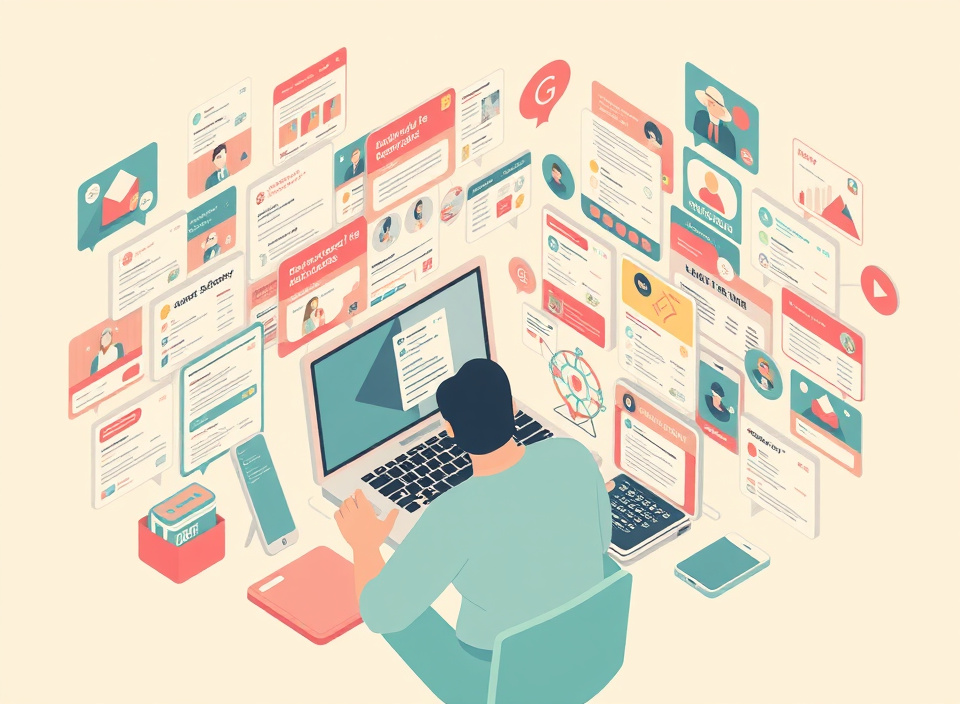
Hyper-personalization means tailoring an individual message to an individual customer using behavioural signals in close to real time, rather than sorting people into a handful of static buckets. The operational cost of this is the part vendor pitches tend to leave out: a program that used to run five campaign variants now needs potentially thousands, one for every meaningful combination of customer attribute and behaviour.
No in-house content team scales linearly with that. Capacity doesn't keep pace with what hyper-personalization demands, and the first symptom is a backlog — creative delivery slows down, and channels that used to launch together start going out of sync, with email lagging a week behind the ad refresh and the website still showing last month's offer.
The practical fix is twofold: centralizing creative assets in a digital asset management system so that variants can be assembled from approved components rather than built from scratch, and using AI-assisted production for the routine variation — resizing, re-wording, re-sequencing — while people focus on the base creative and the exceptions. Once that pipeline exists, personalized variants can ship consistently across web, email, social, and paid channels instead of arriving staggered and inconsistent.
A one-person shop or a small in-house team should treat this as the real gating question before adopting hyper-personalization: not "can we buy the tool" but "can we produce and maintain the number of variants the tool will ask for."
How finely you can segment before it stops working
Hyper-segmentation is the practice of splitting an audience into progressively smaller groups to increase message relevance — it sits between broad segmentation (a handful of customer types) and full personalization (one message per person). The appeal is obvious: a tighter segment should mean a more relevant message.
The limit is statistical, not creative. Every time a segment is split, two things shrink at once — sample size and the reach of any single campaign sent to it. Push the split too far and a segment becomes too small to deliver meaningful reach or to generate stable results: one campaign to a segment of forty people can look like a huge win or a total failure purely on the strength of two or three individual outcomes. Campaign performance becomes volatile, and cost per result rises because the fixed cost of designing, approving, and sending a campaign gets spread across fewer and fewer recipients.
The practical response is consolidation: merge segments back up to the smallest size that still holds enough data volume to produce a result worth trusting, rather than splitting purely because the data allows it. This sets a genuine ceiling on hyper-segmentation that pitches promoting "infinite granularity" tend not to mention — granularity has a floor, set by sample size, below which it stops producing information and starts producing noise.
Individual targeting needs consent before it needs data
Targeting individuals accurately requires detailed personal and behavioural data — location, purchase history, browsing patterns, device signals. That data is also exactly what makes targeting feel intrusive when a customer can't tell where it came from: an ad that references a product someone looked at on a different site, with no visible connection between the two, reads as surveillance rather than service.
That perception has a direct cost. When customers can't trace why they're seeing a particular offer, trust falls and opt-in rates drop, which shrinks the very data pool the targeting depends on — a feedback loop that undermines the whole approach from the inside.
The sequencing fix is to treat consent capture and data governance as a prerequisite, not a compliance afterthought bolted on at the end. That means: a clear, visible record of what was collected and why, an opt-in mechanism that precedes any individual-level targeting, and a data retention and sharing policy a customer could actually read and understand. Skipping this step doesn't just create regulatory exposure — it directly degrades the data quality that hyper-personalization depends on, because distrustful customers give false signals, use ad blockers, or opt out entirely. The privacy concern that gets listed as a one-line "con" of hyper marketing is better understood as a required early step, not a risk to manage later.
Hyper marketing, defined
"Hyper marketing" isn't a single discipline with a textbook definition — it's an umbrella term for marketing that pushes targeting and personalization to the most granular level the available data allows, rather than a specific technique or platform. In practice it covers four related but distinct approaches, each targeting a different unit — the individual, the platform-profile segment, the micro-segment, and the location:
| Approach | Unit of targeting | What drives it |
|---|---|---|
| Hyper-personalization | The individual customer | Real-time behavioural and transaction data |
| Hypertargeting | A narrowly defined ad audience | Platform profile and behavioural attributes |
| Hyper-segmentation | A small customer segment | Splitting broad groups until relevance rises and sample size allows |
| Hyperlocal marketing | A small geographic radius | Location and proximity to a physical point of sale |
Understanding hyper marketing as this cluster of four approaches, rather than one tactic, matters because each has a different data requirement, a different failure mode, and a different minimum scale at which it's worth doing — conflating them is how a small business ends up trying to build individual-level personalization when hyperlocal targeting around its one storefront would have answered the actual need.
Hypertargeting
Hypertargeting delivers advertising to narrowly defined audiences built from platform-declared and inferred profile attributes — age, interests, job title, past engagement — rather than broad demographic buckets like "women 25–44." It's the approach most directly tied to ad platforms themselves, since the audience definitions are built inside the ad manager using whatever targeting fields the platform exposes.
The tradeoff is reach versus precision: a hypertargeted audience is more likely to respond, but it's also small enough that a campaign can exhaust it quickly, and frequency can climb to the point of fatigue well before a broad campaign would. It works best layered on top of a broad campaign that's already been analyzed for which segments underperform — using that analysis to build the narrow audience, rather than guessing at interest categories from scratch.
Hyperlocal marketing
Hyperlocal marketing targets customers within a very small geographic radius — a few blocks or a single neighborhood — rather than a city, region, or country. It's the standard approach for businesses tied to a physical location: a dealer, a restaurant, a local service provider, where the customer's proximity to the storefront is the single strongest predictor of whether they'll convert.
The practical mechanics are different from the other three approaches because the targeting variable is physical rather than behavioural: location-based ad radius settings, geofencing, and local search listings do the work that behavioural segmentation does elsewhere. For a single-location business, hyperlocal targeting is often the one form of "hyper" marketing that's achievable without building any of the data infrastructure the other three require — it needs an address and a radius, not a customer data platform.
What an online marketer actually does, and how someone becomes one
An online marketer is someone who plans, runs, and measures marketing activity across digital channels — search, social, email, paid ads, content — rather than a single discipline. Internet marketing itself breaks down into several distinct practice areas, and the job of "online marketer" usually means owning one or more of them rather than all at once: content marketing, search engine optimization, pay-per-click advertising, social media marketing, email marketing, affiliate marketing, and more are commonly treated as the core set a practitioner specializes within.
Becoming one typically follows a recognizable path rather than a single certification:
- Build foundational skill in one or two channels — most commonly content, paid search, or social ads — through free platform documentation, courses, or a guided program.
- Produce a portfolio of real or simulated campaigns, since hiring managers and clients weigh demonstrated results over credentials.
- Take on freelance or small-business clients to build a track record, which is the path Emeritus's guide to freelance digital marketing frames as the fastest way into the field without an agency job first.
- Specialize as a generalist skill set plateaus — moving toward a specific discipline like paid media, lifecycle email, or SEO as a deeper specialty.
- Track outcomes (not just activity) for each campaign run, since the ability to show a measurable result is what separates a marketer who gets repeat work from one who doesn't.
On pay, Hilbert College's breakdown of the digital marketing specialist role frames compensation as tied closely to specialization and experience level rather than a flat industry rate — a generalist entry-level role and a specialized paid-media or analytics lead sit at very different points on the same job title. Freelancers and independents, per the same freelance-path guidance, set their own rates based on channel expertise and client results rather than a fixed salary band, which means "do digital marketers get paid well" has no single answer — it depends on specialization, whether the marketer is employed or independent, and the measurable results attached to their name.
The common thread across every one of these paths and every "hyper" variant above is the same: none of it works without first establishing what a broad campaign is actually doing wrong, before buying the tools to fix it.